
We’re in a new era of work. Employees expect more. Remote teams are redefining connection. And burnout is everywhere. A new study suggests that up to 66% of US employees are experiencing burnout. That’s why workplace wellness programs need to take center stage. I don’t just mean providing gym stipends or annual checkups. I mean creating the kind of culture that attracts top talent, keeps them engaged, and offers them the wellness support they need.
HR is uniquely positioned to lead this shift and drive real business impact along the way. Because when you support your people holistically, you improve morale and protect your bottom line. And in today’s business climate, we can’t afford to separate the two.
Let’s unpack what makes these programs matter and how you can build one that actually moves the needle.
What Are the Benefits of Employee Wellness Programs?
We’ve come a long way when it comes to workplace wellness programs. Today, they address the full human experience: physical, emotional, financial, social, and beyond.
When you think about employee wellness, you tend to think that it must be separate from the workplace experience. But the two are very closely connected. When employees feel supported in all aspects of their lives, they show up better. For themselves, their teams, and the business.
Here’s the data to back it up:
If there’s one thing I’ve learned in all my years of talent acquisition, it’s this: people can’t perform at their best if they’re struggling behind the scenes.
How Do Employee Wellness Programs Benefit Employers?
I talk to global talent leaders daily, and the pressure is on. They’re expected to attract top talent, keep them, and do more with less. But adding workplace wellness programs is more than just another initiative to add to the list. The right wellness strategy can be a force multiplier for all of your metrics.
We’ve covered benefits like higher productivity, lower absenteeism, but what will actually move the dial? Here’s what employers stand to gain from a well-structured workplace wellness program:
These are the kind of numbers CFOs notice. And the kind of strategic value HR should be proud to deliver.
What Are the 7 Areas of Wellness?
Depending on where you look, you’ll see a different number of areas of wellness to cover. But these seven cover a holistic range that can be supported by a strong workplace wellness program.
These include:
- 1
Physical: Movement, nutrition, sleep, and preventative care.
- 2
Emotional: Mental health support, stress management tools, and counseling.
- 3
Social: Human connection through team-building and inclusive culture.
- 4
Financial: Tools for budgeting, debt management, and retirement planning.
- 5
Intellectual: Continuous learning, curiosity, and development.
- 6
Career: Job satisfaction, purpose, and manageable workloads.
- 7
Environmental: Safe, clean, and inspiring workspaces (whether in-office or remote).
That’s why a good wellness program provides more than just a gym membership and a checkup! There are a lot of wellness areas that make a happy, healthy person able to take on the fast pace of the modern workplace.
How Much Does a Workplace Wellness Program Cost?
Cost is a common concern, but it’s not a one-size-fits-all situation. A wellness program can range from a few dollars per employee per month to more comprehensive solutions costing $150–$1,200 per employee annually. It depends on your scope and goals.
But here’s the ROI:
A report by Wellhub found that businesses see an average ROI of $2 for every $1 spent on wellness programs. That’s a pretty good return for your investment in your most important business asset, your workforce.
5 Steps to Create an Employee Wellness Program
As VP of Talent Solutions, I’ve helped companies navigate the most complex recruitment challenges. The most successful organizations aren’t just winning on skills or scale, they’re winning on people-first cultures. That starts with wellness.
So here’s my top tip for HR and talent leaders: don’t wait for burnout to hit your bottom line. Don’t let well-being be an afterthought. Take the lead.
Here’s how to get started:
Step 1. Listen First
Survey your employees. Use focus groups. Find out what matters to them. A generic program won’t move the needle. Tailor your approach based on real needs: mental health, financial literacy, stress relief, etc.
This is really important in the current economy. According to the Bank of America, only 19% of workers are on track for retirement. This means financial wellness in the workplace is more important than ever. Look at your workforce demographics. Are young people getting competitive salaries? Are your older workers on the right 401K program?
What’s really telling is that the primary sources of work-related stress are:
Look at your company culture and see if there are inefficiencies in communication and management expectations contributing to these stressors.
Step 2. Set Clear, Measurable Goals
Define success before you start. Whether it’s reducing healthcare costs by 10%, improving engagement scores, or improving retention. Know your “why” and track progress.
Step 3. Secure Executive Buy-In
Leadership support is critical. Wellness should be seen as strategic, not optional or just a gimmick. Show the ROI, link it to business goals, and get leadership actively involved.
Step 4. Communicate and Integrate
Even the best workplace wellness programs fail if no one knows about them. Build internal campaigns, use storytelling, and make wellness part of your culture. That means it should be integrated into daily workflows, not just a once-a-year event.
Step 5. Measure, Adapt, and Improve
Use metrics like:
And most importantly, don’t be afraid to pivot. The best programs evolve with your workforce.
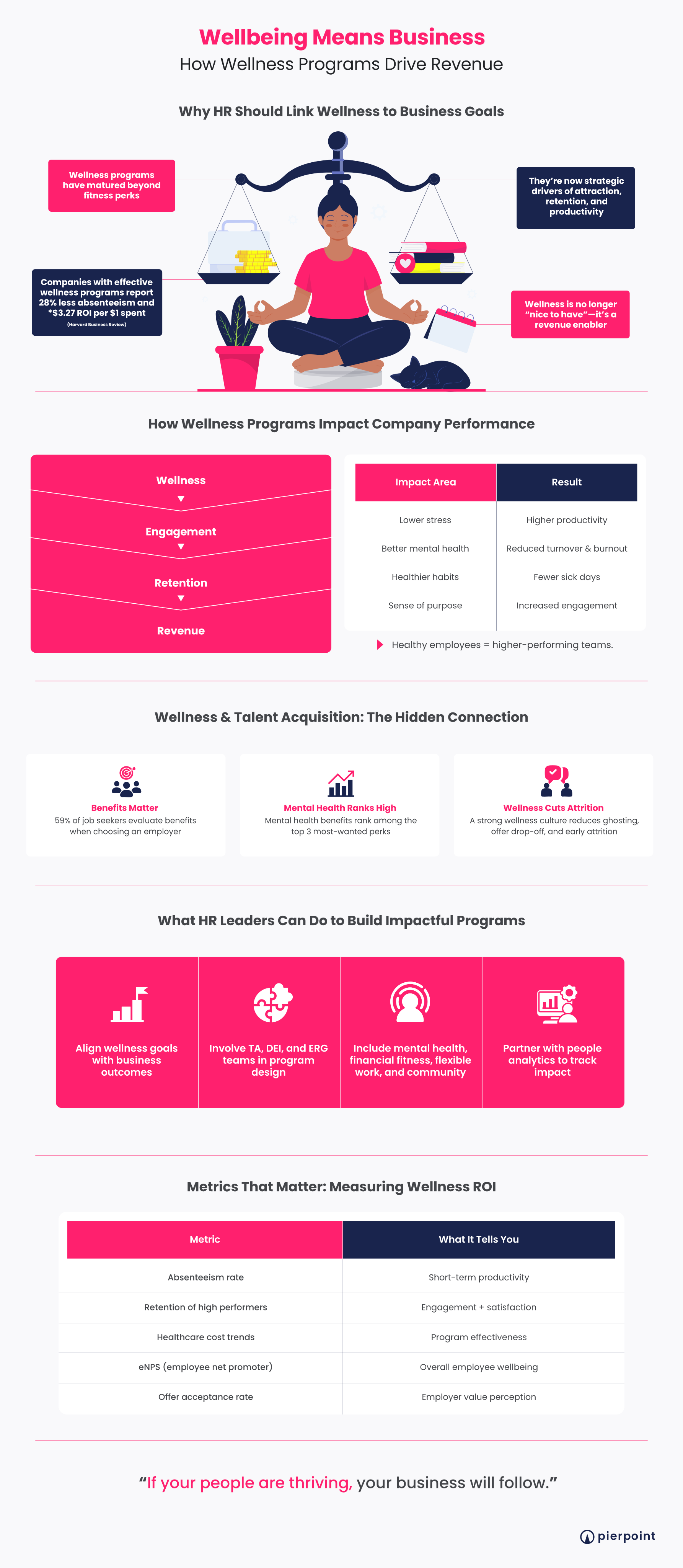
Take the Lead on Wellness and Watch Performance Follow
Want to launch (or relaunch) a workplace wellness program that actually delivers value? Build a workplace wellness program that truly supports your people. Not just to check a box, but to drive loyalty, resilience, and growth in a world that demands more from all of us.
The smartest companies are already moving. HR leaders who seize this moment can drive value and define what a modern, future-ready workforce looks like. Now’s the time to embed wellness into your strategy and watch the ripple effects across your organization.

With over 17 years of experience in RPO recruitment solutions, Jill Rosenfield is a recognized leader in creating strategic talent solutions for global organizations. As the VP of Global Talent Solutions at Pierpoint International, Jill specializes in delivering customized recruitment strategies for large global fortune 500 companies, as well as mid-tiered and small businesses.
Jill works with organizations to develop innovative workforce strategies, including full and partial RPO, recruiting on demand, contract recruiting, and executive search. Her expertise spans consultative problem-solving, solutions architecture, and a wide range of talent services, from sourcing and talent mapping to competitive intelligence and payroll management.
Explore More Talent Acquisition Insights

Supporting Manager Burnout in the Age of Doing More With Less
Learn how to prevent manager burnout with strategies that support leaders facing the pressure to do more with less.

Connecting Top Talent with Global Clients for Success in DEI Recruiting
Hear from Michelle Schmidt, a successful DEI recruiting professional, for insight into creating diverse & inclusive workplaces for global success.

How To Spot a Dishonest Candidate and What To Do About It
Learn how to recognize potential candidate misrepresentation, verify qualifications, and address concerns during hiring.