
This year has seen the lowest hiring plans from US employers since 2009. Tighter budgets, economic uncertainty, and shifts in organizational structures mean many businesses are looking to do more with less. But the problem is that reduced hiring doesn’t cure the underlying skills gap that threatens productivity and long-term growth.
The key drivers of this gap are:
However, there is a solution. Recruitment Process Outsourcing (RPO) experts spend so much time assessing the skills and talent market, they’re perfectly positioned to help you fill positions, upskill, and evolve your existing workforce with or without hiring.
Skill Gap Statistics
Let’s look at some of the hard numbers to contextualize the workforce skills gap (and why urgent action is needed).
These skills gap statistics highlight how big the problem is. Similarly they show how important it is to find a solution if hiring isn’t an option. Unfortunately, doing nothing will only make the skills gap widen further.
How to Identify A Skills Gap
Before you can close the gap, you need to understand what skills your teams are missing. Here’s how to conduct a skills gap analysis:
However, many organizations underestimate the effort and resources required for this. Most internal HR teams don’t have the bandwidth (or the data visibility) to run a full workforce skills gap analysis. Especially one that runs across multiple functions and job levels while also accommodating future growth plans and technology implementations.
That’s why many companies turn to RPO providers to help.
How RPOs Can Help You Conduct A Skills Gap Analysis
How Can RPOs Help You Bridge the Skills Gap?
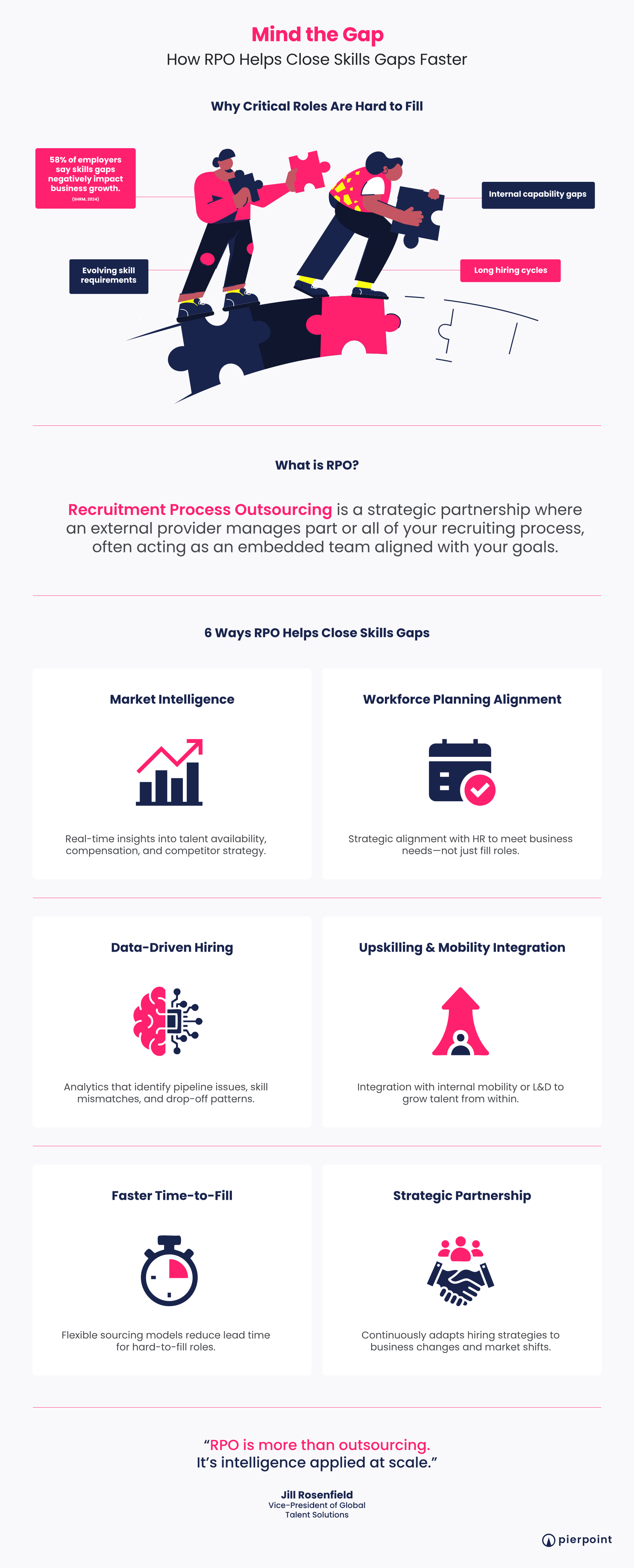
Aside from supporting skills gap analyses, partnering with an RPO provider can help you source the skills you need without hiring.
Here’s how they help:
#1 Strategic Workforce Planning
RPO providers can develop a comprehensive workforce plan and identify your current and future talent needs. They can assess which roles you’ll need in the future and assess your current workforce for any stand-out internal candidates who would be a good fit. RPOs can help you with entire workforce mobility strategies to help internal talent move where they’re needed.
#2 Training and Development
RPOs can help you build and design training and upskilling programs to prepare internal talent for specific roles. Closing the gap between what you need and what the market currently supplies.
#3 Data-Driven Insights
RPOs use analytics to identify talent gaps and recommend talent strategies. They help you answer not just “who to hire” but “what skills to build”. They can help you decide when to choose outsourced teams over internal hiring, and how to align external resources with internal strategy.
Additionally, they can review your HR tech stack, suggest areas for improvement and either plug the gap with their own tech and tools, or help you onboard the right tools for the job.
#4 Market Intelligence
Because RPOs operate across industries and geographies, they bring visibility into new in-demand skills. As well as compensation trends and workforce supply challenges that your internal team might miss.
#5 Retention strategies
Finally, RPOs can help you hold onto the talent you already have. When you can’t hire to fill skills gaps, holding onto your existing workforce is very important. RPOs can help you assess your employer brand, company culture, and benefits offerings to reduce turnover.
When Your Business Evolves, So Should Your Talent Strategy
If your talent strategy right now revolves around a hiring slowdown, use this time to rethink how you build capability. Now is the time to design the workforce that will help your business succeed in the next few years.
That starts with a disciplined, data-driven workforce skills gap analysis, then choosing the right talent levers to pull. An RPO partner can help you understand whether that means upskilling internal teams, tapping a new talent pool, or outsourcing.
If you’re ready to move beyond reactive hiring and build a talent strategy that scales with your ambitions, let’s talk.

Greg Vaughn, Sr. Director of Program Delivery at Pierpoint International, is an accomplished leader in global RPO and talent acquisition with over 20 years of experience. He has led recruitment teams supporting Fortune 500 companies with over 4,500 hires annually, as well as small to mid-sized organizations with more targeted hiring needs.
Greg’s expertise includes designing and managing complex, end-to-end recruitment solutions that optimize talent acquisition processes and tools, integrate recruitment marketing and social media strategies, and provide talent mapping and executive placement services across EMEA, LATAM, and North America. His approach emphasizes team collaboration and a strong customer focus, consistently achieving high levels of client satisfaction.
Explore More Talent Acquisition Insights

Overcoming the Manufacturing Skills Gap
Discover 5 strategies that will help your business overcome the skills gap in the manufacturing talent market.

Diversity in Recruiting: Uncovering Inclusion
Understand workplace covering, its impact on inclusion, and how organizations can help employees feel comfortable being themselves.

Top 5 Strategies for Sourcing Passive vs Active Candidates
Learn the top 5 strategies for sourcing passive vs. active candidates and how to implement those in your organization.