
Retail is in the midst of a major transformation, and not just on the customer side. Consumers expect seamless digital experiences, same-day delivery, and endless product options. But the people working behind the scenes are under pressure. Consequently, retailers are struggling not only to hire but to retain talent. It’s time to rethink how we build and scale a talent pipeline strategy in retail. Because maintaining the status quo won’t work.
People are the most important part of any brand, business, and service. So in the race to modernize and stay competitive, retail’s approach to talent development needs to change.
What’s Wrong With the Retail Talent Pipeline?
The average retail turnover rate is 60.5% in the US. To put that in context, the average turnover rate across industries is 15%. But why is it so hard to retain and develop talent in retail?
Retail Is Declining as an Industry
Retail was once a reliable career path. It was diverse, fast-paced, and full of advancement opportunities. But now, it’s facing an identity crisis. Between automation, e-commerce disruption, and shifting consumer habits, retail is shrinking.
There are 18,007,377 people employed in retail in the US as of 2025, and growth is expected to decline by 0.4% this year.
Economic uncertainty and store closures, particularly among name brands, have created a cloud of uncertainty over the future of retail jobs. And the average retail business now employs fewer workers than it did five years ago.
The traditional growth paths in the industry are disappearing. That’s fewer physical stores, fewer jobs, fewer development opportunities, less mentorship and thinner middle management.
Upward Mobility Isn’t As Clear Anymore
There used to be a well-worn path to the top in retail. You put in the work, earned the experience, and moved up. But today, those stories are becoming rarer, and that’s a problem.
Take Costco, for example. CEO Craig Jelinek started out in 1984 as a warehouse manager. He climbed the ladder, becoming EVP of Merchandising in 2010, and eventually CEO in 2012. Now, he’s stepping down and handing the reins to Ron Vachris, another Costco lifer who began his career driving a forklift.
This talent pipeline strategy should be the norm, not the exception. But in most retail organizations today, there’s a massive disconnect between frontline roles and executive-level opportunities. Employees don’t see themselves in leadership, because the path to get there is unclear.
Entry-Level Turnover Is Staggering
If the goal is to develop great leaders internally, step one is keeping them long enough to develop. Unfortunately, retail has one of the highest turnover rates of any industry, at 60%.
When turnover is this high, building a sustainable pipeline becomes nearly impossible. You’re constantly filling gaps, instead of building up skills. And this constant churn impacts operations, culture, customer experience, and long-term growth potential.
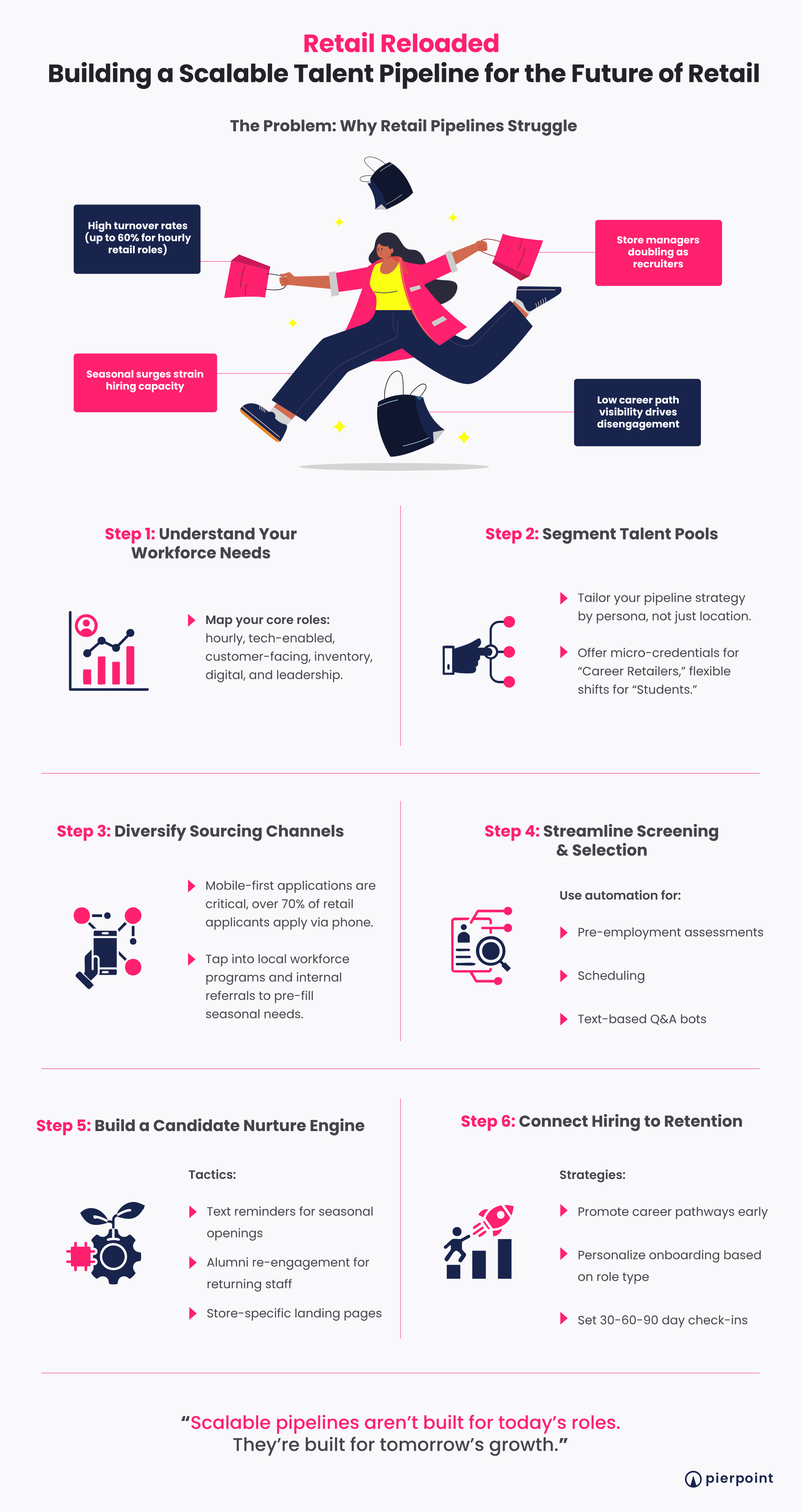
How Do You Build a Talent Pipeline in Retail?
I’ve seen organizations waste millions chasing short-term fixes. Posting more job ads and building headcount only to end up right back where they started. What actually works? Building a long-term, scalable talent pipeline strategy that puts people at the center, not just processes.
It’s beyond solving the talent gap, it’s about creating an environment where people want to stay. That means creating a future for everyone with a pipeline.
How to Build a Talent Pipeline:
To build a strong, scalable talent pipeline strategy in retail, you need to be intentional, consistent, and people-focused. Here’s how to make it real:
When you build a talent pipeline strategy that’s backed by data, you solve the talent shortage from the frontline all the way to the boardroom.
That’s the power of a truly scalable talent pipeline.
Turn Your Frontline Into a Leadership Pipeline
You need to understand what the frontline is experiencing. When I’m working with clients, I always recommend that leadership spend time on the floor. Whether it’s in a store, warehouse, or distribution center. I’ve done it myself. You see firsthand where communication breaks down, where workflows are inefficient. And, most importantly, who’s quietly going above and beyond. That’s where future leaders show up.
Your next store leader could be today’s cashier. Your future COO might be stocking shelves right now. But if you don’t have a strategy to find, nurture, and retain them, you’ll never know.
Finally, it’s time for a new kind of talent playbook. One that doesn’t treat entry-level retail jobs as disposable, but as the starting line for long, meaningful careers. Ultimately, we need to move beyond transactional hiring to build transformational careers.

With over 17 years of experience in RPO recruitment solutions, Jill Rosenfield is a recognized leader in creating strategic talent solutions for global organizations. As the VP of Global Talent Solutions at Pierpoint International, Jill specializes in delivering customized recruitment strategies for large global fortune 500 companies, as well as mid-tiered and small businesses.
Jill works with organizations to develop innovative workforce strategies, including full and partial RPO, recruiting on demand, contract recruiting, and executive search. Her expertise spans consultative problem-solving, solutions architecture, and a wide range of talent services, from sourcing and talent mapping to competitive intelligence and payroll management.
Explore More Talent Acquisition Insights

What’s Driving Healthcare Employee Retention Issues?
Find out what's driving healthcare employee retention challenges and how employers can reduce turnover and improve employee experience.

Recruiting During a Crisis: How to Source Healthcare Workers
Get approaches to sourcing and screening healthcare workers when staffing needs change rapidly during a crisis.

Connecting Top Talent with Global Clients for Success in DEI Recruiting
Hear from Michelle Schmidt, a successful DEI recruiting professional, for insight into creating diverse & inclusive workplaces for global success.