
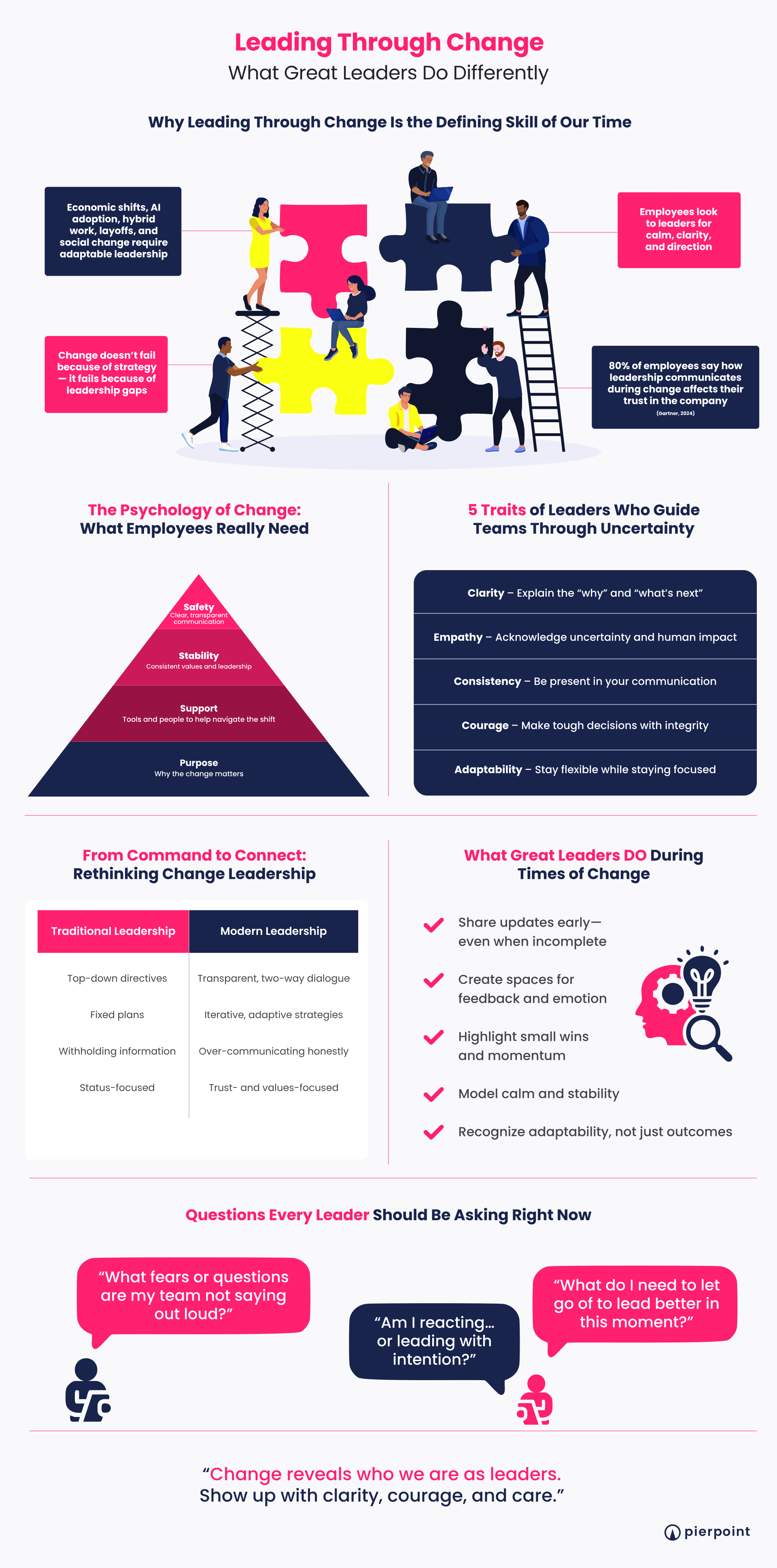
Working in HR, you soon come to understand this truth: change really is constant. Whether it’s restructuring, scaling globally, implementing new technology, or adapting to external market shifts, it never stops. And when change hits, it’s HR leaders who are often expected to carry the emotional and strategic weight. But leading through change isn’t about weathering a storm until it passes. It’s about steering the ship with clarity, empathy, and courage through the storm and bringing your people with you.
Having supported numerous global enterprise clients through change and guided my own teams at Pierpoint International through disruption, change management is close to my heart. That’s why I wanted to outline why leadership is more critical now than ever and how the concept of “change leadership” is evolving. I’ll also share seven practical steps HR executives can take to guide their organization through uncertainty with purpose and strength.
Why is Leadership Important During Periods of Change?
In 2016, KPMG estimated that 96% of companies were undergoing some form of change. Fast forward to 2024, and McKinsey estimated that 90% of organizations are undergoing some form of digital transformation. That’s eight years of constant change, technology implementations, new systems, new processes, uncertainty, mergers and acquisitions, hiring drives, restructurings, etc.
When change is constant, especially without clear communication or strategy, people start to disconnect. They feel overwhelmed, undervalued, and unsure of where things are headed.
Understandably, burnout is at an all-time high. According to a recent study by The Harris Poll, 76% of employees and 63% of managers report feeling burned out or ambivalent in their current role.
The top driver of burnout? That constant change. That was followed closely by “unnecessary work” and “shifts in focus.” The impact isn’t just emotional; it hits the bottom line too. Disengagement leads to poor performance and high turnover. And guess who ends up managing that churn? HR.
That’s why an intentional, strategic approach to leading through change is important.
Examples of HR Leading and Managing in Times of Change
Let me give you two real-world examples where I’ve seen the importance of strong HR leadership through significant transitions:
Example 1: Transitioning Employees to a New Standalone Company
Imagine a major biotech firm spinning off part of its business into a standalone company. Naturally, fear would ripple across the organization: “Will I still have a job?” “What’s going to change?” “Do I matter in this new structure?”
In this scenario, the most effective HR leaders wouldn’t just roll out org charts and new titles. They’d bring employees along for the journey: hosting town halls, setting up mentorship networks, and clarifying purpose.
The likely result? A smoother transition with minimal attrition and a deeply motivated new workforce.
Example 2: Aligning Top Leadership to Promote Change
Consider a high-tech company undergoing fast global expansion. If the executive team isn’t aligned on priorities, that misalignment quickly filters down, and employees feel the confusion.
In a situation like this, facilitating alignment sessions across C-level leaders can help create a unified front. From there, leaders can cascade a consistent message throughout their teams. This would lead to improved morale and renewed focus, sometimes in just a matter of weeks.
In both cases, what makes the difference is not just managing the change, but leading it.
Introducing: “Change Leadership”
As HR executives, you’re not just implementers. You’re culture shapers. And during uncertain times, that responsibility grows exponentially.
I’ll be honest, the first time I heard the phrase “change leadership,” it resonated with me. Over the years, I’ve seen so many organizations focus solely on change management. Change management is about tools, timelines, and tactical plans. It’s necessary, but not sufficient. Change leadership, on the other hand, is about guiding people through the emotional and strategic impact of change. It’s about creating belief, not just processes.
It recognizes that people don’t resist change because they’re stubborn. They resist it because they fear the unknown. With 37% of employees resistant to change, effective change leadership means addressing that fear with empathy, clear communication, and a compelling vision.
How to Be an Effective Leader in Times of Change
When I’m asked for advice on leading through change, I always say it’s a balancing act between structured processes and emotional intelligence. That change-leadership/change-management dynamic.
Here are the seven strategies I most often recommend to clients and peers for successfully leading in times of change:
#1. Emphasize Relationship Building
Change is personal. Before people buy into a new system or strategy, they need to feel seen. Prioritize one-on-one time with key team members and create space for trust to grow. Your influence starts with connection.
#2. Build Alignment
A study found that:
Your senior leaders must be singing from the same songbook. If they’re not, it creates confusion across the entire company. Your employees should get a personalized message about how change impacts their role, day-to-day activities and team from their direct managers, while executives should mirror key messages in company-wide communications.
#3. Create a Compelling Case for Change
People need to understand why the change is happening. What is really impactful to communicate is what’s at stake if you don’t change?
Use real data, market trends, and competitive insights to paint a clear picture.
#4. Establish a Clear Vision and Course of Action
Leading in times of change without direction is chaos. A compelling vision gives people something to aim for, while a concrete plan reduces uncertainty. Make the roadmap visible and repeat it often.
#5. Commit to Listening and Responding
I’ve scoped out a multi-tiered change communications program, but you also need to listen as much as you talk.
Create feedback loops. Pulse surveys, listening sessions, and manager debriefs can help you spot trouble early. And when people speak up, respond so your workforce feels heard.
#6. Recognize and Celebrate Successes
Even small wins matter. Celebrating progress gives your team the energy to keep going. It signals that the change is working and that they’re doing it right.
#7. Be Patient and Understanding
Change takes time. People process it at different speeds. Expect bumps, make space for emotions, and show compassion along the way.
Lead the Change Your Organization Needs
If there’s one thing I’ve learned from leading in times of change, it’s this: strategy matters, but people matter more.
HR executives are uniquely positioned to lead with both head and heart, to combine data-driven decisions with deep empathy for the human experience. If we get that balance right, we can transform difficult transitions into opportunities for growth and resilience for everyone involved.

Alyssa Terrizzano is the Co-Founder and CEO of Pierpoint International, where she leads the company’s growth and business strategy. With extensive experience in talent acquisition and human resources, Alyssa has a strong background in recruitment and managing teams in the medical tech, biotech, and high-tech industries.
Alyssa's focus on creating collaborative work environments and supporting team development helped establish her as a recognized leader in the HR and Recruitment Process Outsourcing (RPO) sectors. Alyssa holds a Bachelor of Science in Human Resources and an MBA, and values teamwork in addressing challenges.
Explore More Talent Acquisition Insights
The 7 Best Inclusive Recruitment Practices
Discover the top 7 inclusive recruitment practices that can improve talent acquisition and help embed inclusion in your organization.

Going Global: Creating a Branded Candidate Experience Across Multiple Countries
Learn how to create an effective global branded candidate experience and see how it can benefit your organization.

A Toolkit for Supporting Women in Leadership
Find the best ways to support women in leadership in your organization with this toolkit for developing leadership skills.