
HR leaders are facing a difficult contradiction. They are under pressure to improve productivity while engagement scores are slipping and burnout claims are rising. According to Gallup, employee engagement in the U.S. fell to 32% in recent years, while stress levels remain elevated across industries. At the same time, business leaders continue to demand more output, faster delivery, and leaner teams.
The real issue is not that distributed teams cannot perform. It is that many companies are still using office-era productivity systems in a remote or hybrid world. If we want to improve productivity in distributed teams, we have to redesign how work is structured, measured, and supported.
What Causes Burnout in Distributed Teams
Burnout in distributed teams does not happen because people are at home. It happens because expectations are unclear, visibility is inconsistent, and digital work never truly stops.
Several consistent drivers show up across industries:
We can’t blame burnout in distributed teams on motivation. It is a systems issue. When HR leaders want to improve productivity, the first step is to examine whether the system itself is driving exhaustion.
How Do You Measure Productivity Without Increasing Pressure?
The fastest way to decrease productivity is to measure it poorly.
Usually, organizations equate activity with impact. Online status indicators, email response times, and meeting attendance become proxies for performance. These metrics create stress but rarely improve business outcomes.
If you want to improve productivity without increasing pressure, shift your measurement model:
When HR partners with leadership to redefine performance metrics, you create space to improve productivity through focus rather than fear.
How to Improve Your Distributed Teams’ Productivity Without Burning People Out
Improving distributed team productivity requires structural change. It is not about asking people to try harder, but helping them work smarter within a sustainable framework.
Here are practical steps HR leaders can champion:
Establish Communication Norms
Define response-time expectations. Not every message requires an immediate reply. Clear norms protect focus time.
Protect Deep Work Blocks
Encourage meeting-free windows. Leaders should model this behavior. When calendars are full, quality declines.
Conduct Regular Workload Calibration
Managers should review capacity, not just deadlines. Ask simple questions: What is realistically achievable this week? What can wait?
Train Managers in Distributed Leadership
Managing by walking around does not translate to hybrid work. Managers need guidance on coaching remotely, spotting burnout signals, and leading through outcomes.
Increase Visibility of Contributions
Create shared dashboards or progress summaries that highlight accomplishments. When work is visible, employees feel less pressure to constantly prove themselves.
Reevaluate Tool Sprawl
Every new platform adds complexity. Consolidate where possible. Fewer tools often mean clearer execution.
When companies take these steps, they do not just improve productivity. They reduce friction and restore focus.
How Do You Build a Culture of Sustainable Performance?
High performance and wellbeing are not opposites. They reinforce each other when the system is designed intentionally.
A sustainable performance culture rests on four principles.
When HR designs policies, training, and performance frameworks around these principles, organizations can improve productivity while preserving employee energy.
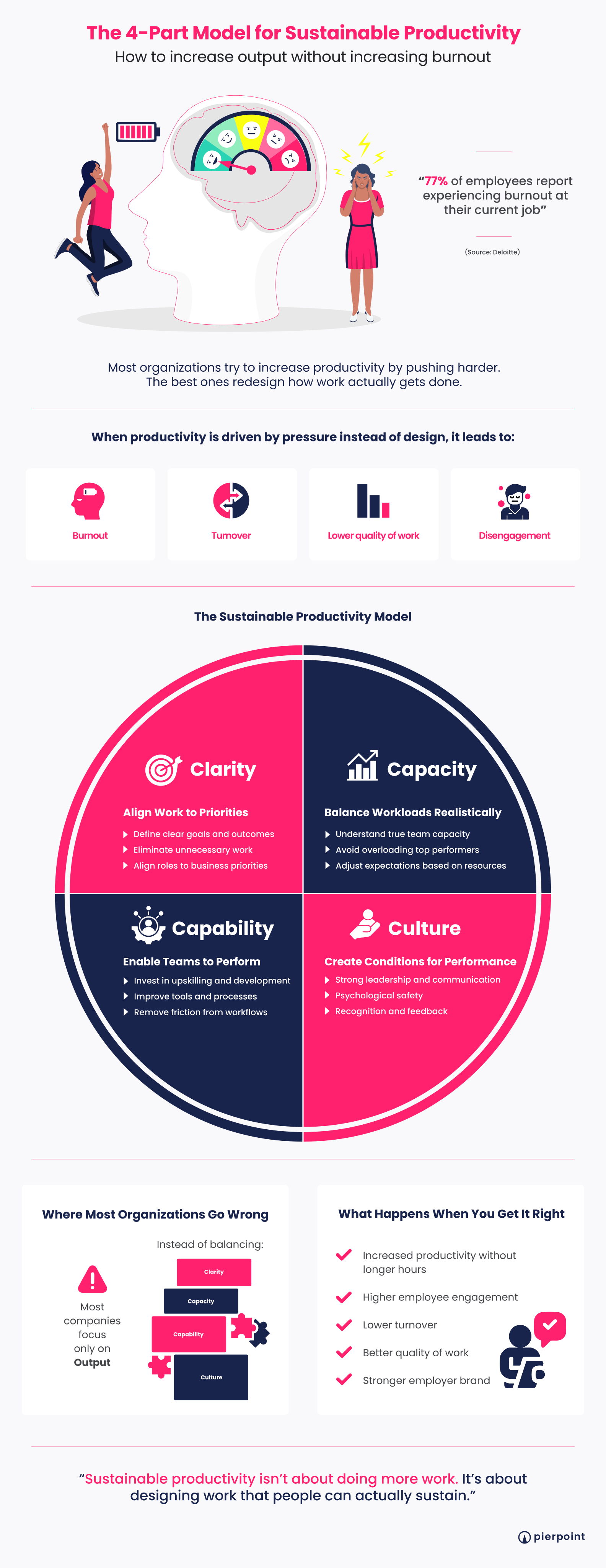
Practical Framework: The 4-Part Model for Sustainable Productivity
To operationalize this, HR leaders can use a simple four-part model.
#1. Clarity
Define priorities quarterly. Align team objectives to business goals. Communicate what success looks like in concrete terms.
#2. Capacity
Assess workload realistically. Use data from time tracking, project management tools, and manager check-ins. Adjust before overload becomes burnout.
#3. Communication
Standardize collaboration norms. Clarify which channels are for urgent matters and which are for asynchronous updates. Protect focus time.
#4. Culture
Encourage transparency about workload. Train managers to recognize early signs of exhaustion. Reward smart execution, not constant availability.
This framework provides structure without adding bureaucracy. It creates guardrails that allow teams to perform consistently. When organizations apply this model, they move from reactive burnout management to proactive performance design.
Productivity Should Not Cost Your People
Distributed productivity can’t focus on trying to squeeze more from people. It is about redesigning systems so focus improves and burnout declines. If you are an HR leader navigating this shift, start with a few deliberate actions:
Review whether your talent model supports sustainable growth. Are you scaling responsibly, or relying on overstretched high performers?
The organizations that truly improve productivity in distributed teams are not the ones that demand more hours. They are the ones that design smarter systems.
Distributed work is here to stay. The companies that thrive will be those that treat productivity and wellbeing as interconnected, not competing priorities.
When HR leads this conversation, you position your organization to build resilient teams that scale with strength, retain top talent, and perform without sacrificing people along the way.

Greg Vaughn, Sr. Director of Program Delivery at Pierpoint International, is an accomplished leader in global RPO and talent acquisition with over 20 years of experience. He has led recruitment teams supporting Fortune 500 companies with over 4,500 hires annually, as well as small to mid-sized organizations with more targeted hiring needs.
Greg’s expertise includes designing and managing complex, end-to-end recruitment solutions that optimize talent acquisition processes and tools, integrate recruitment marketing and social media strategies, and provide talent mapping and executive placement services across EMEA, LATAM, and North America. His approach emphasizes team collaboration and a strong customer focus, consistently achieving high levels of client satisfaction.
Explore More Talent Acquisition Insights

5 Ways To Make Your Interview Process More Inclusive
See how you can make your interview process fairer and more inclusive and get tips on writing more inclusive interview questions.

Outsourcing Recruitment: How To Make It Easy
Discover how outsourcing your company's recruitment efforts can help you achieve your hiring goals faster and more efficiently.

Learn the Tech or Lose the Talent: Understanding Specialized Skills
Get to know why tech recruiters need to stay up-to-date, to ensure they better manage candidates with highly specialized skills.