
In recruitment marketing and talent acquisition, the best way to show what it’s like to work for you isn’t through job ads or your website. They’re sitting at desks, joining Zoom calls, and solving problems alongside you every day. An employee advocacy program turns their lived experience into a strategy. It’s how you unlock voices that already carry credibility in the market, deepen employee engagement, and make your brand more human.
Employee advocacy has a big impact. According to LinkedIn, even if only 3% of employees share content about their company, those posts can increase engagement for a company by 30%.
What Is An Employee Advocacy Program?
Think of it as giving your people both the permission and the power to talk about your company in their own words. Not scripts. Not forced hashtags. Just authentic experiences and insights, amplified through their networks.
And here’s why it works: people trust people a lot more than they trust logos.
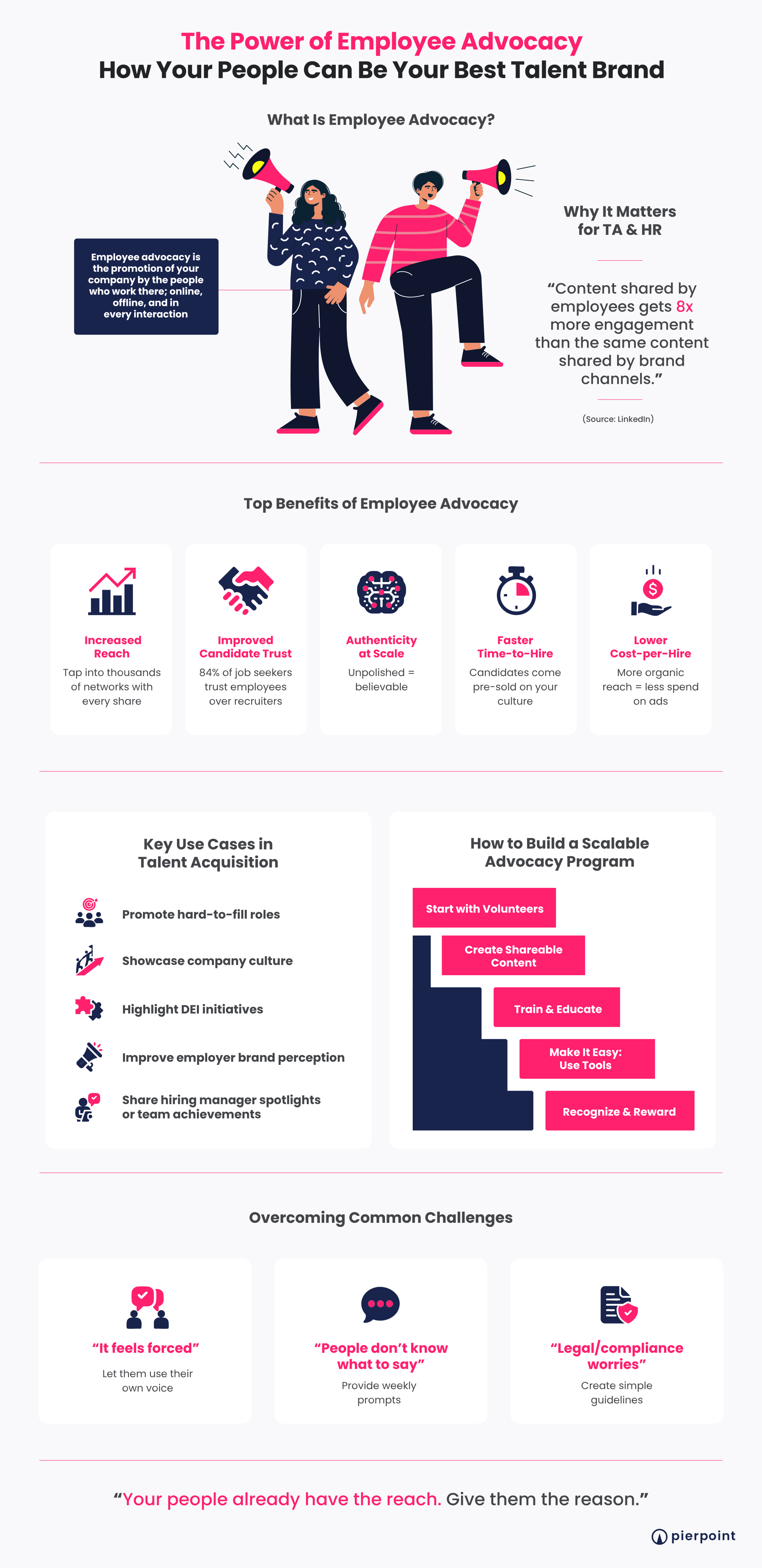
One study found that content shared by employees gets 8x more engagement than the same content shared by the brand. People want to know what employees think about your company. They respond better to real voices, real perspectives, and real content.
And here’s the part I love most: it doesn’t require a huge budget. It requires intention, leadership commitment, and a willingness to let your employees shine.
Benefits of Employee Advocacy Programs:
I’ve seen the ripple effect first-hand. When employees share company stories, four things happen at once:
Real-World Employee Advocacy Examples:
Some of the most successful advocacy programs don’t look like “programs” at all. They really just look like communities. Here are a few examples of employee advocacy programs from some well-known names:
While they’re all different there is a pattern. Authenticity. Support. Freedom. Because when employees speak in their own voice, people listen.
How To Create an Employee Advocacy Program That Sticks:
I’ve helped organizations launch employee advocacy programs across multiple countries, and the most sustainable ones share a few key ingredients.
To create an employee advocacy program, follow these steps:
Step #1: Set Clear Goals:
First, like any well-thought-out HR program, it’s a great idea to know the “why” and “how” of your program before you start.
Define the specific goals you want to achieve. This could be increasing brand awareness, improving employee engagement, attracting top talent, or generating leads.
Step #2: Choose the Right Platform(s):
Second, understand where your target audiences are most active. Those are the platforms and channels where your employees should share content. There are even platforms you can use to help with enhanced social sharing.
Step #3: Spread The Word:
Next, communicate the goals of your program to your workforce and invite people to participate. Provide training on how to use the right channels, the basics of business communication, content creation, and where to find relevant industry trends to comment on.
Step #4: Create Engaging Content:
Create a content plan that resonates with your business values, your target audience, and your workforce. Then make sure that content is easily accessible for employees to customize, share and promote.
Authenticity is key. Encourage your workforce to adapt all content to their tone of voice. They should only share content that really strikes a chord with them, their role, and their audience. Not every post will be relevant to everyone.
Step #5: Reward Advocates:
You could have a leaderboard of the most likes, comments and shares! You could offer incentives, rewards, or do public shout-outs.
It’s really important that your people are recognized for their hard work. Posting company content isn’t part of their core job. They already have responsibilities and priorities to manage, and advocacy is something extra they’re taking on.
Step #6: Monitor and Improve:
Finally, track the performance of your employee advocacy program using engagement metrics, KPIs, and even direct employee feedback. If someone is getting great traction on one channel for an audience you hadn’t considered, pivot and recalibrate.
And above all: connect it to something bigger than marketing. Advocacy should live inside your talent strategy, your culture initiatives, and your leadership values.
How Do You Measure Employee Advocacy?
If you want buy-in, you need proof. The right metrics show advocacy can be a driver of measurable business value.
Here are the metrics for employee advocacy you should track:
Build a Culture Worth Talking About
In conclusion, if your brand story is worth telling, it’s worth telling through credible voices. And those are your employees. Ultimately, in a marketplace where trust is the most valuable currency, employee advocacy is a scalable way to earn it.
Now is the time to make advocacy part of your business strategy. But not as a side project, as a core growth driver. The future belongs to organizations that make advocacy part of their DNA, not just their marketing and talent acquisition plans. Start small, lead with authenticity, and watch influence ripple outward in ways you can measure and celebrate.

Valeria Stupenengo is the Director of Talent Operations at Pierpoint International, with over 17 years of expertise in the RPO industry. She has successfully led multi-functional teams across the U.S., Latin America, and India, delivering tailored recruitment solutions to clients across diverse sectors and contributing to more than 15,000 global hires. Valeria has also overseen operations with an annual P&L of up to $10 million, driving process innovation through the implementation of AI and predictive analytics.
With a Bachelor’s in Social Communication from the University of Buenos Aires and an Executive Program from the Lubar School of Business, Wisconsin, Valeria combines academic knowledge with extensive international experience. Fluent in Spanish and English, with proficiency in Portuguese, she has led large-scale projects in Mexico, Costa Rica, Brazil, and Colombia.
A strong advocate for ESG principles, Valeria is dedicated to promoting diversity and inclusion in hiring and helping organizations align with sustainability goals. Her leadership style is both strategic and empathetic, as she balances her rewarding career with her role as a mother.
Explore More Talent Acquisition Insights

The Retail Hiring Data TA Teams Should Track
Focus on the retail hiring data that matters most, from turnover and hiring speed to workforce planning and retention trends.

Diversity and Inclusion Needs to Be a Top-Down Incentive
How can you create successful EDI policies? Learn starting points, ways you influence as a leader, and where you can create the best impact.

Mergers & Acquisitions: HR Strategies for a Smooth Transition
Learn key HR strategies to manage mergers and acquisitions effectively, minimizing disruption and ensuring workforce stability.