
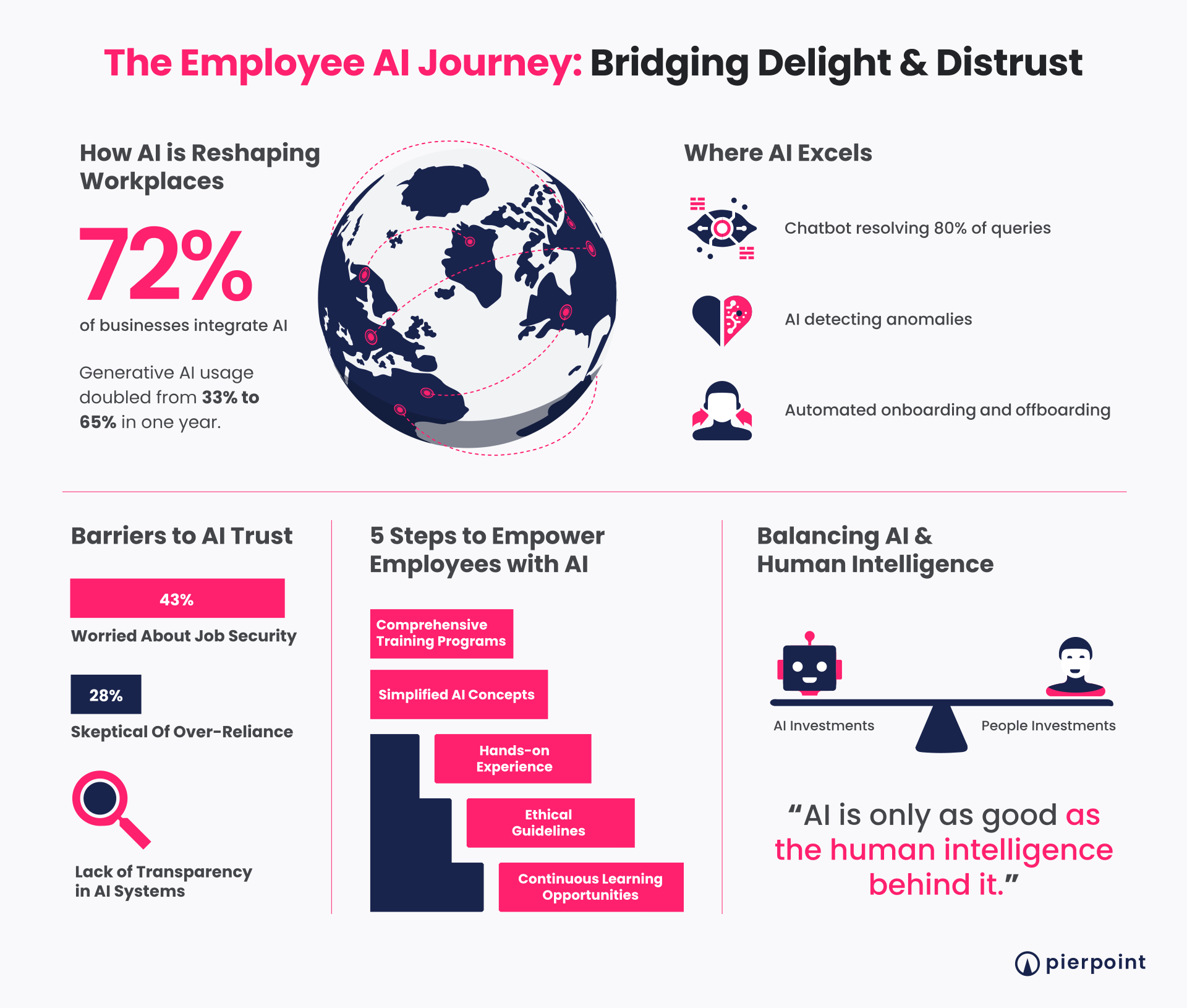
With 72% of businesses weaving Artificial Intelligence (AI) into their operations, the workforce is navigating new ways of working, learning, and collaborating. And the question is, does AI inspire delight or distrust in the workplace? We have a few years of data to understand employee sentiment towards AI, what is working and what is causing concerns. Using that information, HR and talent acquisition leaders can shape the AI journey for employees to better support them and, ultimately, see better results across the board.
How is AI Used in the Workplace?
The AI journey for most employees is well underway.
Generative AI is the most popular form of AI integration in the workplace. In the last year, McKinsey estimates that 65% of organizations regularly used generative AI in at least one business function. This is up from 33% in the year before. It has been used to automate routine tasks, generate personalized responses and text (email, updates, even entire presentations). Giving employees back time that would be spent on these manual activities is one of AI’s biggest appeals.
Take customer service as an example. AI-powered chatbots can resolve up to 80% of routine inquiries, freeing employees up to focus on higher-value tasks. Additionally, industries like healthcare and finance are leveraging AI to detect fraud, forecast trends, and even personalize patient care. Hours of manual work can now be produced in mere minutes or hours.
AI is also supporting HR functions in many ways, like employee engagement surveys, performance reviews, automating onboarding and offboarding processes, and much more. So outside of the day-to-day tasks of an employee’s role, AI is more broadly shaping their experience with their employers.
AI in the Hiring Process
Even before an employee becomes an employee, AI is part of their experience. In fact, the AI journey for employees starts with the hiring process. From applicant tracking systems (ATS) that sift through resumes to AI-driven interview platforms analyzing candidate responses, companies use AI to enhance hiring efficiency.
But the quality of these tools can significantly shape how potential employees perceive an organization. Imagine a candidate interacting with a poorly implemented AI system—applications get lost in automated filters, or AI misinterprets key qualifications, or unconscious biases are perpetuated by the data the algorithms use. The result? Frustration and a diminished employer brand.
A well-implemented AI-powered recruitment process can increase a candidate’s confidence in you as an employer. For example, AI algorithms that are carefully taught and have clean data run through them can assess candidates impartially, minimize unconscious bias, and improve diversity and inclusivity.
It’s important to note that when AI is used well in the recruitment process, candidates can have an exceptional experience and look favorably on you as an employer that communicates well and is forward thinking in how it enacts its values. SAP research shows that between 45-57% of people said they would react positively if a company used AI tools in the hiring process, believing the hiring process to be more fair.
Employee Attitudes to AI in the Workplace
Despite the time savings and improved working experience AI can bring to the workplace, employees have expressed concerns about AI in three major areas:
Interestingly, the research suggests that the sentiment towards AI for employees depends on their existing AI literacy. SAP’s research suggests that people with high AI literacy are less anxious in general about the impact of AI on their futures. And were also more likely to have positive or egalitarian perceptions about how AI usage should – or should not – impact decisions like performance reviews, career advancement, and compensation.
Support the AI Journey for Employees: Training & AI Literacy
Fear of the unknown drives a lot of the feelings towards AI for employees. So empowering employees with the skills and knowledge to work effectively with AI is essential for fostering trust and seeing a better return on investment.
In my experience helping companies implement upskilling strategies, employees need to be reassured that an investment in AI is still an investment in their future.
Try these five tips to build AI literacy in your teams:
By investing in training and AI literacy, companies can ensure the AI journey for employees is a nurturing and positive process.
Final Thoughts on Employee Attitudes to AI
It’s clear that for some employees, AI is an enabler, and for some, it’s a concern. We need to reinforce the idea that AI is only as good as the human intelligence behind it. Our workforces are still the lifeblood of business, and we need to balance AI investments against people investments, ensuring that a step forward for one is a step forward for the other.
If you’re looking for support with talent development strategies or with implementing AI within your recruitment process, recruitment process outsourcing solutions from Pierpoint could be right for you. Learn more about our talent solutions, or book a call today to discuss your talent needs.

Valeria Stupenengo is the Director of Talent Operations at Pierpoint International, with over 17 years of expertise in the RPO industry. She has successfully led multi-functional teams across the U.S., Latin America, and India, delivering tailored recruitment solutions to clients across diverse sectors and contributing to more than 15,000 global hires. Valeria has also overseen operations with an annual P&L of up to $10 million, driving process innovation through the implementation of AI and predictive analytics.
With a Bachelor’s in Social Communication from the University of Buenos Aires and an Executive Program from the Lubar School of Business, Wisconsin, Valeria combines academic knowledge with extensive international experience. Fluent in Spanish and English, with proficiency in Portuguese, she has led large-scale projects in Mexico, Costa Rica, Brazil, and Colombia.
A strong advocate for ESG principles, Valeria is dedicated to promoting diversity and inclusion in hiring and helping organizations align with sustainability goals. Her leadership style is both strategic and empathetic, as she balances her rewarding career with her role as a mother.
Explore More Talent Acquisition Insights

How to Minimize Bias in Your Sourcing, Hiring, and Onboarding Processes
Explore how hiring bias can affect your sourcing, hiring, and onboarding procedures and the best methods to reduce unconscious bias.

Why the Entry-Level Talent Pipeline is Broken and How to Fix It
Why is the entry-level talent pipeline broken? Find out why and what HR can do to resolve it for strong workforce planning strategies.

New Trends Disrupting Talent Acquisition
Stay ahead with the latest trends in talent acquisition and discover strategies to attract top talent in a competitive market.